

Complementary Two Dimensional Carrier Profiles of 4H-SiC MOSFETs by Scanning Spreading Resistance Microscopy and Scanning Capacitance Microscopy | Complementary two-dimensional carrier profile characterization of 4H-SiC MOSFETs using scanning spread resistance microscopy (SSRM) and scanning capacitance microscopy (SCM)
Patrick Fiorenza, Marco Zignale, Edoardo Zanetti, Mario S. Alessandrino, Beatrice Carbone, Alfio Guarnera, Mario Saggio, Filippo Giannazzo, Fabrizio Roccaforte
Abstract
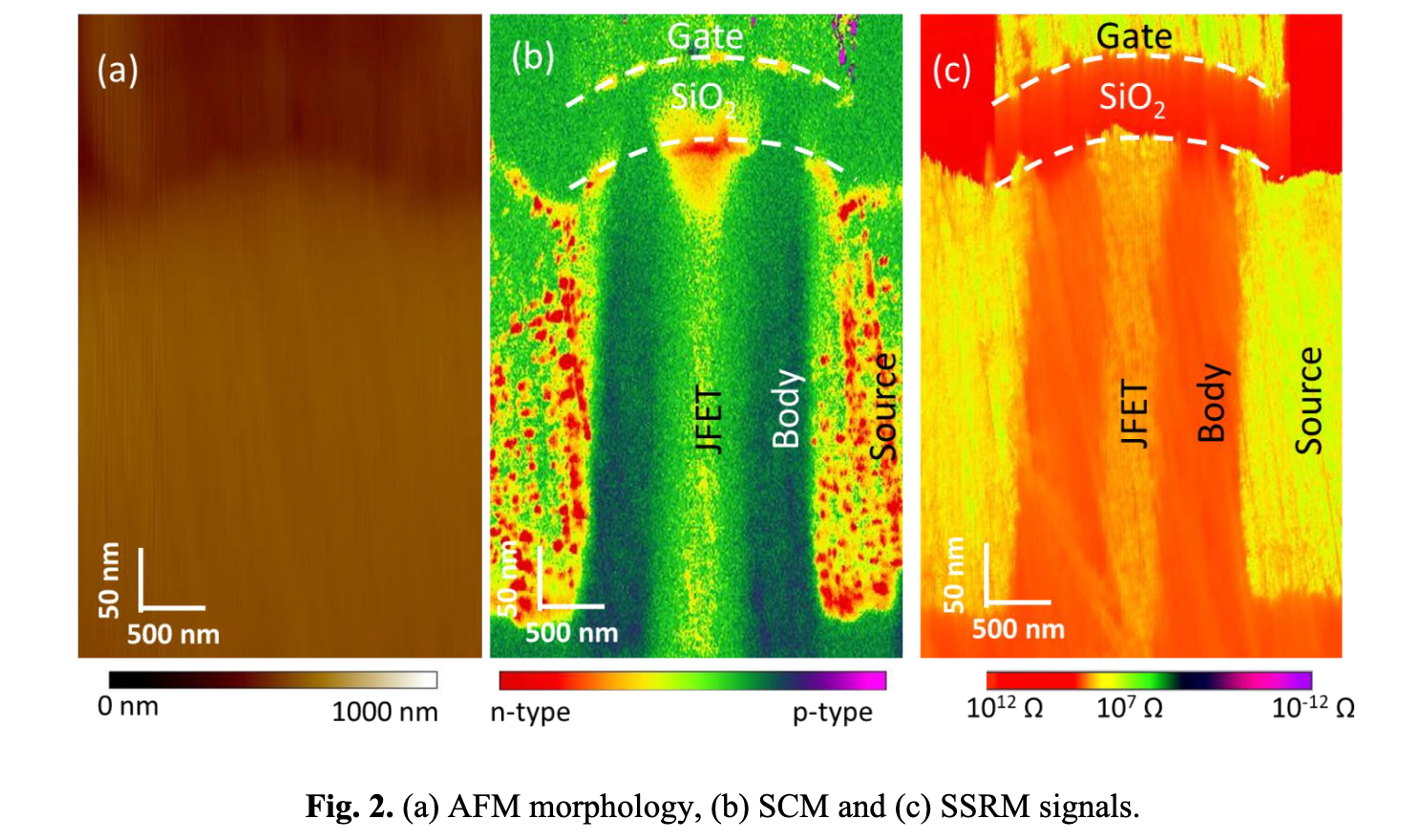
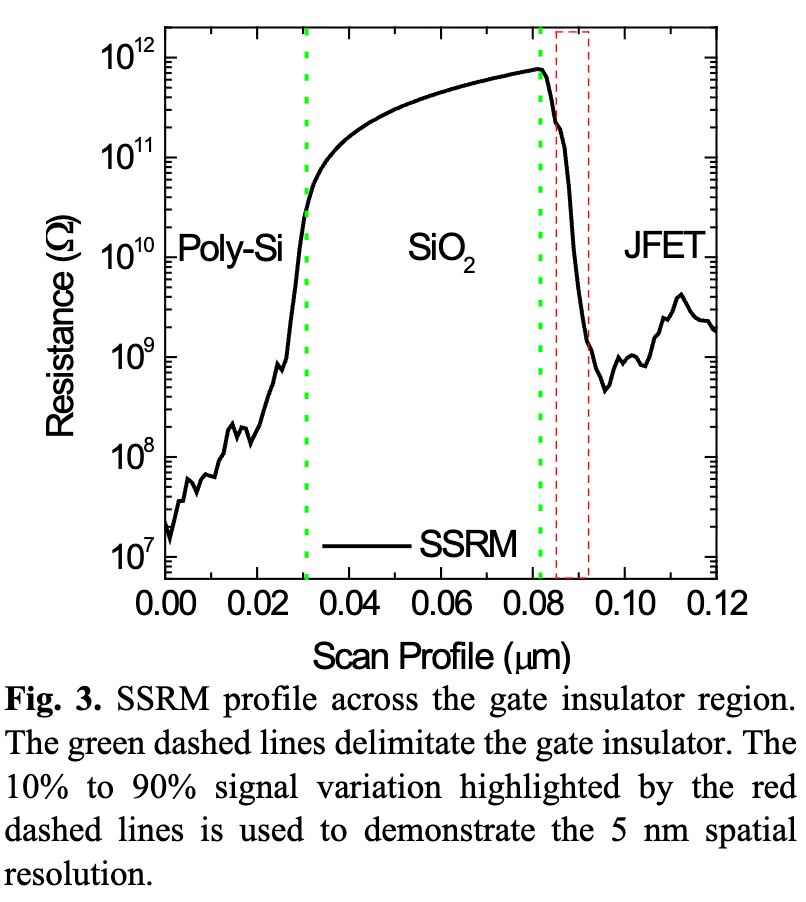
The suitability of scanning probe methods based on atomic force microscopy (AFM)measurements is explored to investigate with high spatial resolution the elementary cell of 4H-SiCpower MOSFETs. The two-dimensional (2D) cross-sectional maps demonstrated a high spatialresolution of about 5 nm using the scanning spreading resistance microscopy (SSRM) capabilities.Furthermore, the scanning capacitance microscopy (SCM) capabilities enabled visualizing thefluctuations of charge carrier concentration across the different parts of the MOSFETs elementarycell.
Summary of the Paper
This study investigates the suitability of scanning probe microscopy (SPM) techniques — specificallyScanning Spreading Resistance Microscopy (SSRM)and Scanning Capacitance Microscopy (SCM) — for two-dimensional (2D) carrier profiling of4H-SiC power MOSFETsat the nanoscale. Using AFM-based methods, the authors systematically characterized the cross-sectional carrier distribution across the elementary cell of 4H-SiC MOSFETs, a wide-bandgap semiconductor of critical importance in modern power electronics.
SSRM delivered 2D cross-sectional resistance maps with a spatial resolution of approximately5 nm, enabling direct visualization of the p-body, n-source, and n-drift regions within the device structure. The complementary use of SCM revealed fluctuations in charge carrier concentration across distinct regions of the MOSFET cell. The joint application of both techniques provided a more comprehensive picture than either method could offer alone.
The work was conducted in collaboration with STMicroelectronics, one of the world's leading SiC power device manufacturers, underscoring its direct industrial relevance. The results demonstrate that SSRM and SCM together constitute a powerful analytical toolkit for characterizing advanced power semiconductor devices at sub-10 nm resolution.
----------
Application and technical value of SSRM
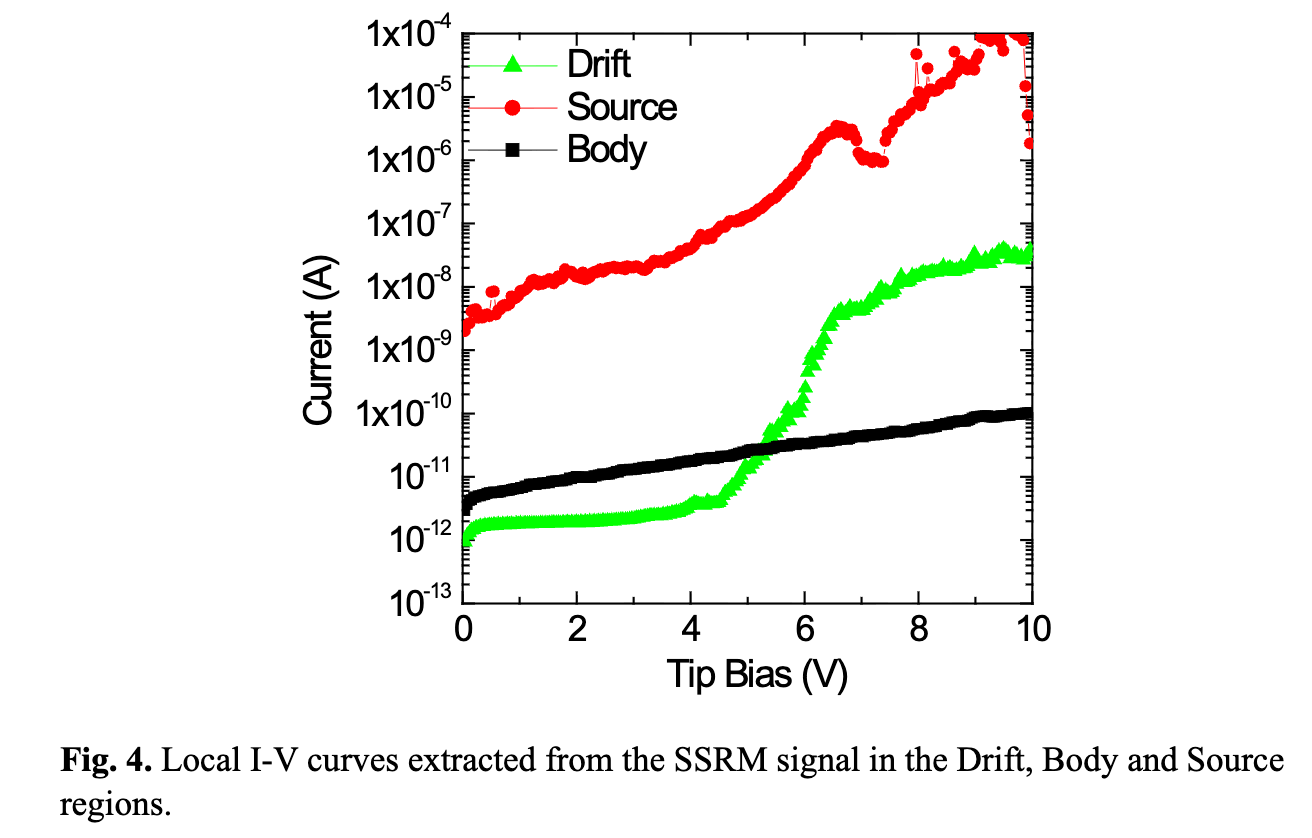
In this study, SSRM was used to perform high-resolution two-dimensional resistance distribution imaging of 4H-SiC power MOSFET cross-sections. SSRM uses a diamond-coated conductive probe to directly contact the sample cross-section, applies a bias voltage and measures the local expansion resistance, and finally reconstructs the resistivity distribution image inside the device. In this experiment, SSRM achieved approximately5 nmWith the spatial resolution, key functional areas such as the p-body region (p-body), n-type source region (n-source) and n-type drift region (n-drift region) in the MOSFET cell have been successfully distinguished. The value of this technology is reflected in the following aspects: First, SSRM can directly measure wide-bandgap semiconductors such as SiC without relying on the oxide layer, overcoming the traditional SCM method's dependence on the oxide layer; secondly, the 5 nm-level spatial resolution allows it to capture the subtle doping gradients inside the device, which is important for optimizing SiC The channel design and threshold voltage control of MOSFET are of great significance; finally, the complementary use with SCM further enriches the quantitative information of carrier concentration and provides a powerful means for process verification and failure analysis of power devices.
Research significance
This study proves that SSRM can be used as a reliable 2D characterization tool for the development and process monitoring of next-generation power semiconductor devices represented by SiC. It has significant industrial application value, especially in the context of the mass production of SiC devices by companies such as STMicroelectronics.
----------
Original link:https://www.scientific.net/SSP.358.45?

