

Break through the limits of human vision! Understand the past and present life of "microscopic detection artifacts" SEM and TEM
Humanity's exploration of the microscopic world has never stopped. When we want to see smaller things clearly, traditional optical microscopes hit an invisible wall - the "diffraction limit" when magnified to about two thousand times. In order to break this wall, scientists gave up light and picked up "electrons". Today, let’s talk about the microscope that currently represents the highest resolution in mankind and is also the two “ultimate eyes” in the fields of semiconductor testing and materials science—the scanning electron microscope (SEM) and the transmission electron microscope (TEM).
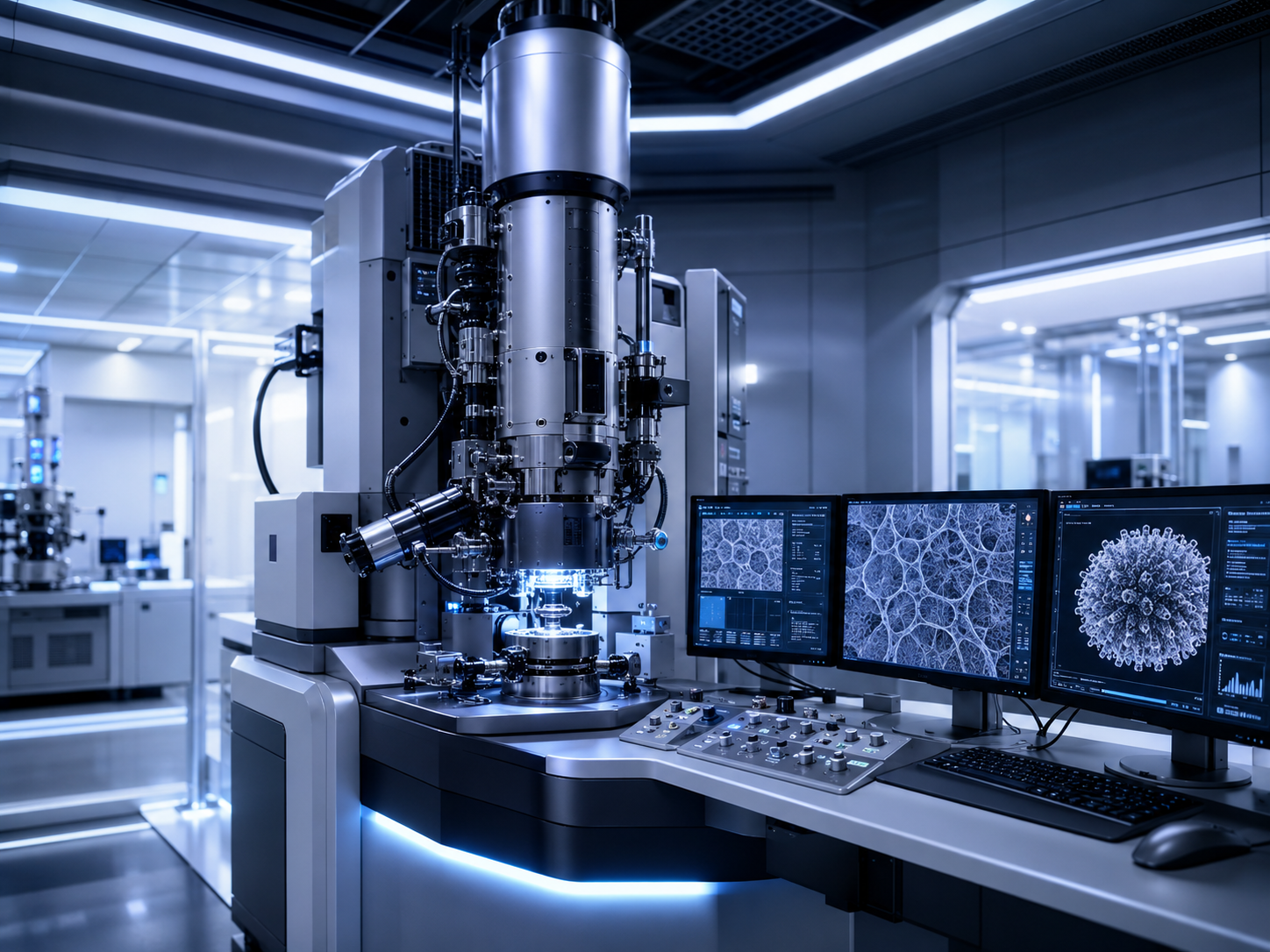
01 Looking at the same microscopic view, what is the difference between SEM and TEM?
Although they are both called "electron microscopes", they look at the world in completely different ways.
🔬 Transmission electron microscope (TEM): the "X-ray machine" of the microscopic world
The full English name of TEM is Transmission Electron Microscope. As the name suggests, its core lies in "transmission".
For example, TEM is like taking X-rays in a hospital. It uses an extremely high-energy electron beam to directly "pierce" extremely thin samples. In the process of penetrating the sample, the electrons will collide with the atoms inside the sample, change direction and energy, and finally leave interlaced light and dark projections on the film.
Its unique skill: extremely high resolution, it can directly see the internal structure of matter, even the arrangement of individual atoms!
The price: The samples must be extremely thin (usually only a few tens of nanometers thick), and the sample preparation process is comparable to "carving patterns on a hair."
🔬 Scanning electron microscope (SEM): the “3D scanner” of the microscopic world
The full English name of SEM is Scanning Electron Microscope. Its core lies in "scanning".
If TEM is taking X-rays, then SEM is like a person holding a very thin flashlight in a dark room and scanning the reliefs on the wall line by line.
The electron beam of SEM does not need to penetrate the sample, but hits the surface of the sample to excite various signals (such as secondary electrons). Detectors collect these signals and, after computer processing, can restore the undulations on the surface.
Its unique skill: The depth of field is huge, and the photos taken have a strong three-dimensional effect (3D effect). It can perfectly restore the surface morphology of objects and has less stringent requirements on samples.
02 A journey of chasing light spanning nearly a hundred years
The history of electron microscopy is much longer than we think.
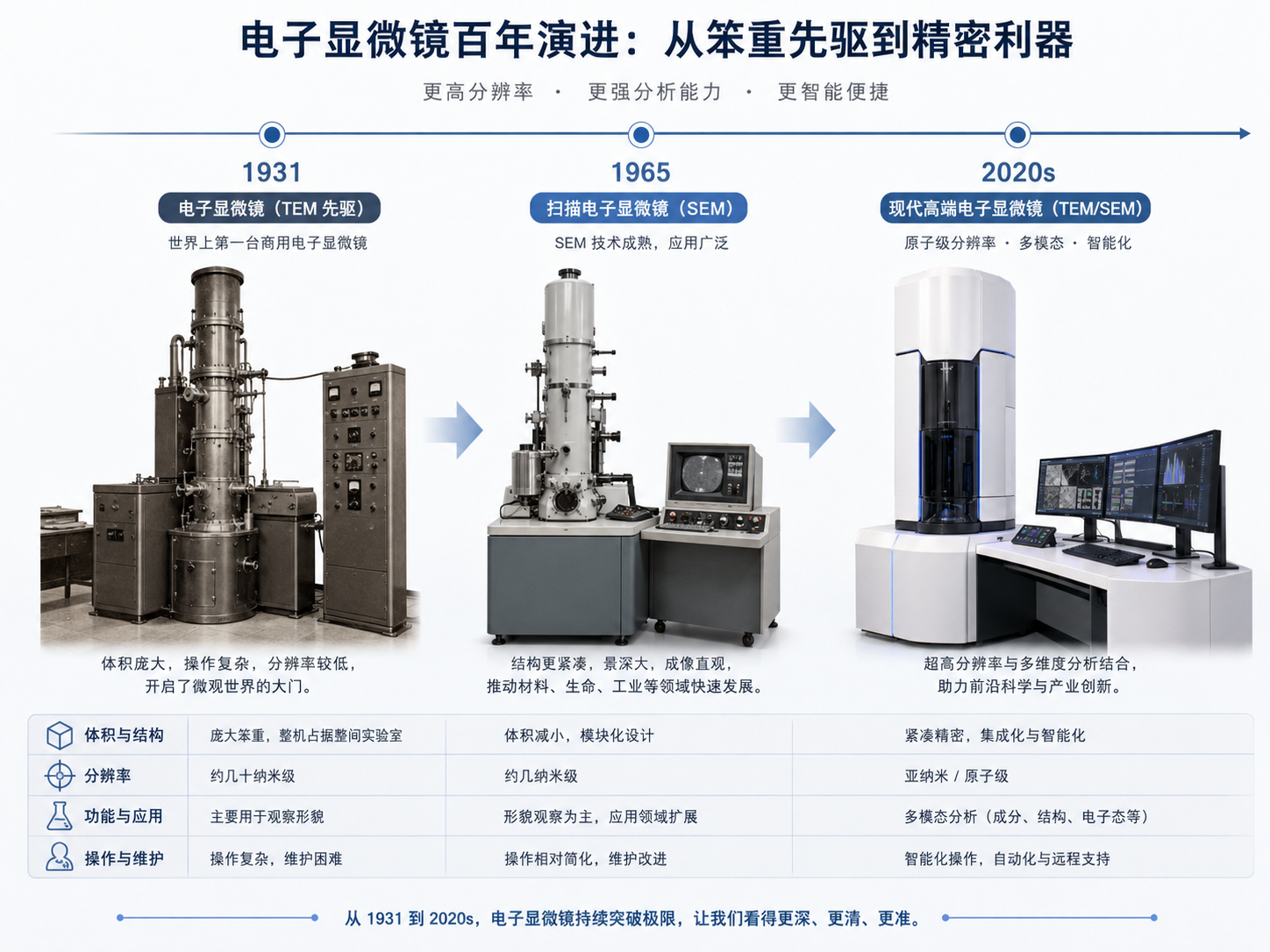
[Breaking Dawn: 1930s] As early as 1931, German engineer Ernst Ruska built an early prototype and completed the world's first transmission electron microscope (TEM) in 1933. Although it could only be magnified more than ten times at the time, it directly proved the feasibility of "electron microscopy", and he himself would later win the Nobel Prize in Physics.
[Commercialization: 1960s] In 1965, the British Cambridge Instrument Company launched the world's first commercial scanning electron microscope (SEM), marking that this technology officially moved out of the laboratory and towards industrial applications.
[The Era of Cyclones: Nearly Thirty Years] What really brought SEM and TEM to the altar and became the most widely used around the world was the rapid development of the semiconductor industry in the past thirty years.
As Moore's Law advances, transistors on chips get smaller and smaller. Today, advanced manufacturing processes have approached the physical limit of a few nanometers. In the wafer factory, traditional optical equipment has long become "blind". Only SEM and TEM can take on the important task of "quality inspectors" to confirm whether the billions of transistors on the chip are etched perfectly.
03 Who is leading this “micro game”?
At present, the global high-end electron microscope market is basically monopolized by the "four major families":
Thermo Fisher (formerly FEI): An American giant that occupies a dominant position in the field of high-end TEM (such as cryo-electron microscopy and high-end semiconductor inspection).
Japan Electronics (JEOL): A well-established electron microscope company with an extremely comprehensive product line and a very high market share in both scientific research and industrial fields.
Hitachi: A Japanese company with strong strength in the field of SEM, especially semiconductor CD-SEM (critical dimension measurement).
Zeiss: The German optical and optoelectronics giant has unique advantages in field emission SEM and dual-beam electron microscopy (FIB-SEM).
There is no doubt that SEM and TEM represent the highest level of human detection of "morphological structure". The semiconductor industry relies heavily on them to confirm whether the chip's etched lines are straight and whether the atomic arrangement is defective.
However, if the structure is perfect, does it mean that the chip can work normally?
The answer is: not necessarily.
Hidden here is a fatal problem between SEM and TEM in semiconductor inspection.limitation:
They can only see the "physical microstructure" and "atomic arrangement", but cannot see the "electrical properties".
In today's extremely complex semiconductor manufacturing processes, many times the physical structure of the chip seems flawless and the atoms are neatly arranged. However, due to abnormal doping concentration, microscopic leakage current, or extremely small resistance changes, the chip cannot be powered on at all.
This is just like when you buy a watermelon, SEM and TEM can help you use the highest definition magnifying glass to check whether there are scratches on the watermelon rind and whether the texture is beautiful, but they cannot tell you whether the inside of the watermelon is sweet or not.
When Moore's Law approaches its limit, structural inspection can no longer fully meet the demand for yield improvement. What is the breaking point of next-generation semiconductor inspection? When SEM and TEM "cannot see" electrical properties, what equipment should we use to detect the microscopic "temper"?
This will be a huge market worth tens of billions.

